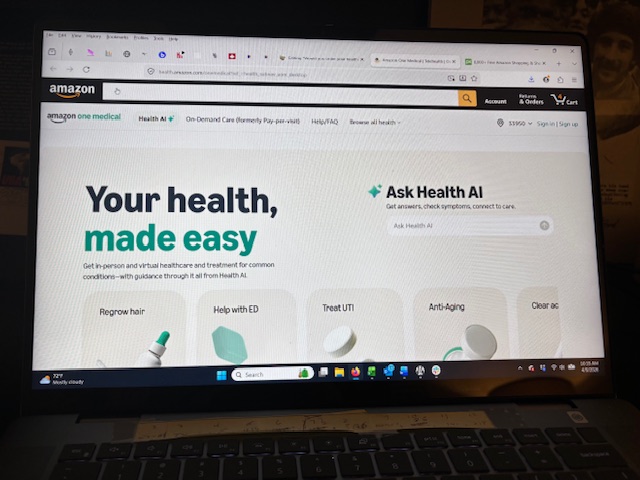
My wife and I ordered some nasal spray from Amazon the other evening. As I expected, confirmation of the purchase quickly appeared in my inbox. What I didn’t expect was a second email, which arrived immediately after the first.
“Thank you for purchasing ‘Flonase Allergy Relief’ . . . from Amazon.com. Your order entitles you to a promotional code. This code grants you $10 off Amazon One Medical Pay-per-visit virtual care services.”
The email ended by instructing me to click a button to select my desired medical treatment and “start it today.”
I didn’t want to “start it today.” I don’t think I like the idea of an Amazon purchase triggering an ad for a health care service, particularly as someone living with multiple sclerosis (MS). But I had to check it out.
Amazon One Medical’s Virtual Visits
Amazon One Medical is an Amazon service that offers people in the US a combination of virtual medical services and actual office visits.
Patients go to the website and select from a list of about 20 basic health conditions—things such as acne, cold sores, and acid reflux. MS isn’t included, but I clicked on urinary tract infection (UTI), a common MS symptom. The cost for a pay-per-visit consultation was $49 for a video visit and $29 for a message visit. The charge isn’t covered by insurance.
Thanks for reading The Multiple Sclerosis Toolbox! Subscribe for free to receive new posts and support my work.
Clicking the button in the ad took me to a page that informed me I could “Get urinary tract infection (UTI) treatment & medicine online.” I had the choice of video or text. The wait for a video consultation would be 10 minutes to an hour, and the wait for a text consultation was 2 to 2.5 hours. (This was at 9 PM Eastern time on a weeknight.)
The One Medical website says these consultations are with a “provider.” This could be a doctor of medicine (MD) or of osteopathic medicine (DO), or a physician’s assistant or nurse practitioner. You’ll learn whom you’re consulting with when you begin your session.
The website cautions that a virtual visit may not be appropriate for you. Before your visit begins, you will complete an intake questionnaire to determine whether you need to be seen in person. “If your answers indicate that we can’t treat you through a telehealth visit, we’ll let you know why, then recommend next steps so you can find the care you need,” the website says.
In-Person Visits
In addition to individual virtual consultations, Amazon One Medical offers a subscription service for hybrid care. With this service, you can schedule an in-person visit at any of Amazon’s medical offices, which span about 20 states and the District of Columbia. Amazon says some medical insurance plans do cover the cost of these visits, whether in-office or virtual.
Amazon Prime members can sign up for this service for $99 a year for the first member and $66 year for up to 5 additional members.
My Concern
In 2022, after acquiring the One Medical primary care company, Amazon said in a news release that it wanted to be “one of the companies that helps dramatically improve the healthcare experience over the next several years.”
That goal is commendable. I’m all for making health care more accessible and affordable.
But using my product purchase to trigger an advertisement for a health care service is a step too far for me. I’m worried about the possibility that my medical interactions could be commingled with everything else under the Amazon umbrella. I think a firewall should exist between what I buy on Amazon and information about my health care.
Maybe I’m overreacting. Amazon and other online merchants regularly use data about my purchases to suggest similar products to me. But the link I received after my nasal spray purchase set off my personal privacy alarm.
Does it also set off yours?
(A version of this post first appeared on the Rare Disease Advisor website.)
(Photo: Ed Tobias)