They soaked me in a hot tub to help diagnose my multiple sclerosis (MS) back in 1980. The physical exam, a lumbar puncture (LP), and an early version of a magnetic resonance imaging (MRI) test sealed the deal.
Things are much better today, but MS is still a tough illness to diagnose. And once treatment has begun, MS progression is difficult to track.
All the usual methods have shortcomings. A physical exam may not do well at tracking progression. An MRI may not show a change until after it has already appeared as a symptom, and it may also be unaffordable for some patients or require travel to a distant facility. An LP might be painful, and scares a lot of people.
In the early 2020s, the neurofilament light chain test (NfL) joined the group of standard tests, but it looks at just a single biomarker and only tracks overall neuroaxonal damage.
Enter the MSDA
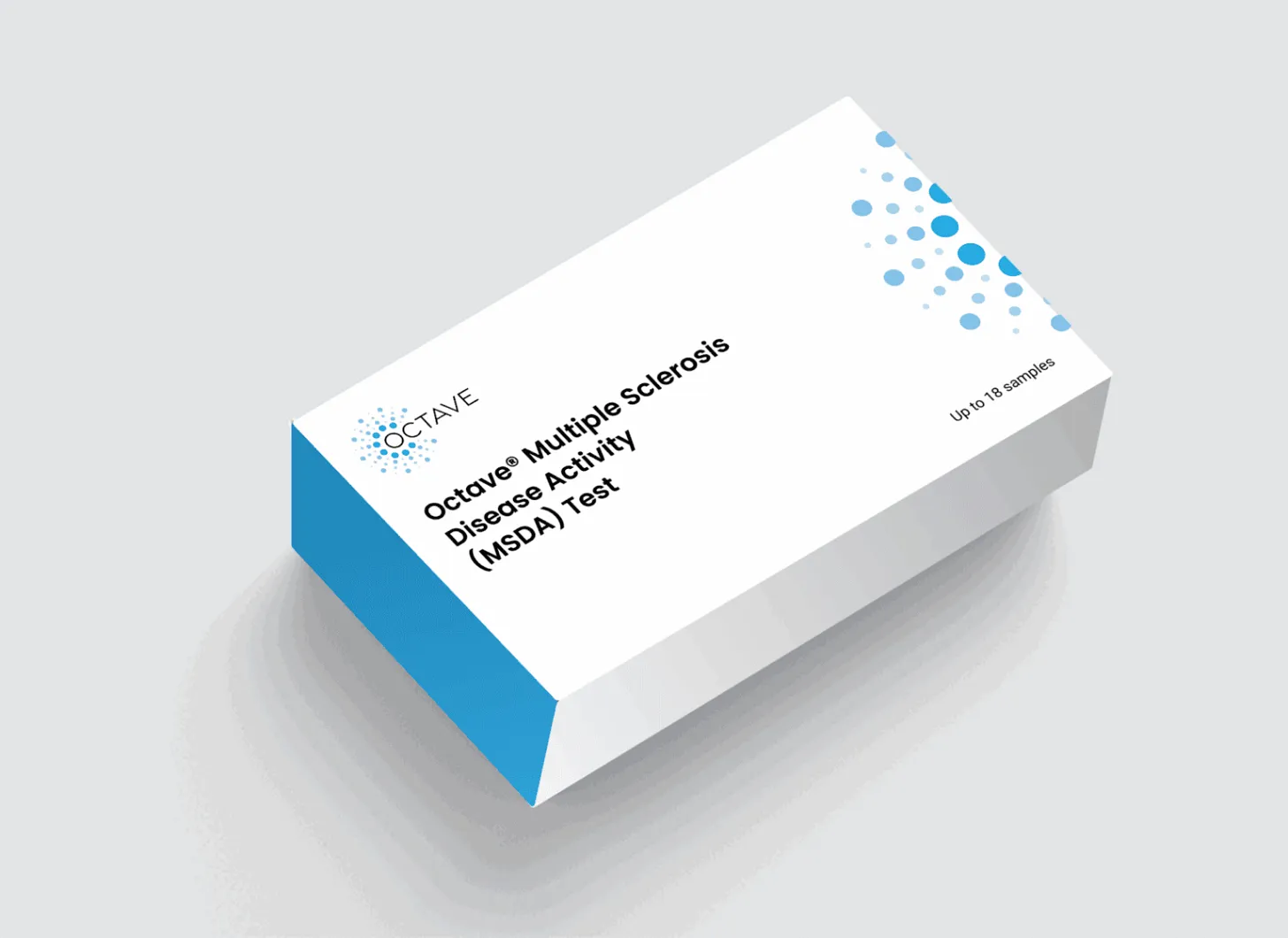
For the past few years a newer test, the multiple sclerosis disease activity test (MSDA), has been growing in popularity. Developed by Octave, it’s a blood test that might be described as an NfL test on steroids.
Recently, the MSDA has become easier to get.
Octave and Quest Diagnostics recently announced a partnership to make the MSDA test available at all of Quest’s thousands of facilities. “The Octave MSDA Test is an important clinical innovation because it harnesses comparatively simple blood testing to illuminate relapse and treatment response in patients with MS, helping to reduce reliance on specialized imaging technologies alone,” said Michael Racke, MD, Quest’s senior medical director of neurology, in a news release.
Multiple Biomarkers and AI Scoring with Octave
The MSDA test measures 18 biomarkers, looking for signals of nerve damage or inflammation. It focuses on 4 things known to drive MS progression:
- Activity in proteins that regulate how aggressively the immune system is behaving
- Changes in the proteins involved in myelin damage or repair
- Markers of axonal injury (similar to what NfL tests detect)
- Inflammatory activity in the central nervous system
Artificial intelligence (AI) is then used to create a score for each of those 4 disease pathways, plus an overall disease activity score indicating low, moderate, or high MS disease activity.
Researchers validated this tool in an Octave-funded study published in the August 2023 issue of Clinical Immunology. Patients with moderate to high MSDA scores were more than 4 times as likely to have at least 1 inflamed lesion as those with low scores. Those with high scores were more than 20 times as likely to have 2 or more lesions.
Using Octave to Adjust Disease-Modifying Therapies
A company-funded review of 325 patient charts from 14 clinics, published in April 2025 in Multiple Sclerosis Journal: Experimental, Translational, and Clinical, showed that using the MSDA could help clinicians determine when—or if—to change a disease-modifying therapy (DMT). “The findings from this retrospective chart review study demonstrate the impact of MSDA on clinician decision-making in MS and provide evidence for the clinical utility of MSDA, particularly when used longitudinally approximately every 6 months to initiate, or switch DMT,” the researchers wrote.
“One of the biggest challenges in MS management is determining when to adjust treatment,” said Taylor Gonyou, DO, a neurologist at the Michigan Institute for Neurological Disorders (MIND) and the study’s lead investigator, in a press release announcing the publication. “This study demonstrates that integrating multi-analyte biomarker data from the Octave MSDA Test into clinical workflows enhances decision-making, particularly with repeated use, as confidence in the MSDA Test grows over time.”
I often see comments in MS social media groups from patients who are concerned about the efficacy of their DMTs, who don’t understand a decision to switch treatments, or whose progression doesn’t show up on an MRI. It’s nice to have another diagnostic tool—one that’s simple to use—that can provide evidence of what’s happening in the nervous systems of people with MS, allowing neurologists to begin or change treatments appropriately.
(This post first appeared on the Rare Disease Advisor website.)
(Image: Fair use from Octave.)